|
The .22 Remington Jet By Chuck Hawks 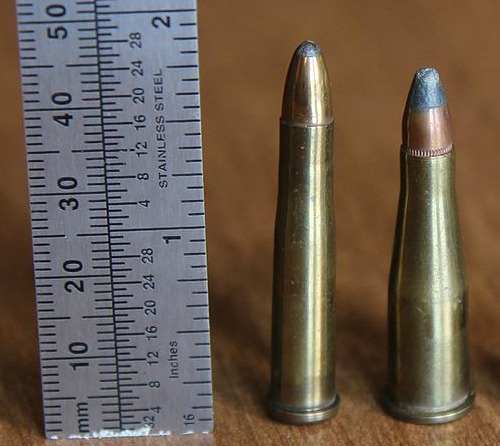 Introduced in 1961, the .22 Jet was developed by Remington for Smith & Wesson. It was intended to be used as a varmint cartridge in a .22 Jet version of a S&W K-frame Masterpiece revolver called the Model 53. At the time the .22 Jet was introduced, the major handgun manufacturers perceived a demand for revolver varmint cartridges. The .22 Jet was Remington's cartridge entry and the .256 Magnum (a more conventionally shaped bottleneck cartridge also based on a necked-down .357 Magnum case) was Winchester's entry. Younger readers have probably never heard of either cartridge, as the perceived demand proved to be nonexistent and neither cartridge worked very well in a revolver. The S&W Model 53 was the only revolver offered in .22 Jet and it was discontinued in 1971, functionally ending the .22 Jet's brief career. The .256 Mag. was adapted to the Ruger Hawkeye, a single shot Peacemaker design, and the Marlin Model 62 Levermatic rifle, where it survived for a few years. Both cartridges are obsolete and long discontinued. Factory .22 Jet ballistics were developed in a 8-3/8 inch (closed breech--not vented) test barrel, as 8-3/8 inches was the longest barrel available on the Model 53. The original Remington factory load ballistics called for a 40 grain JSP bullet at a muzzle velocity (MV) of 2460 fps and muzzle energy (ME) of 535 ft. lbs. These ballistics were considerably overstated and by 1966 the catalog MV had been reduced to 2100 fps and ME to 390 ft. lbs. from an 8-3/8 inch test barrel. The MV from a six inch test barrel was reported in the 1967 Gun Digest as 1870 fps. Most owners found their 8-3/8 inch revolvers actually delivered about 2000 fps and six inch Model 53s actually delivered MVs around 1700 fps (ME 258 ft. lbs.) This loss of velocity was attributed to gas pressure loss due to the revolver's cylinder gap. Interestingly, the Jet's 1700 fps from a 6" revolver barrel still outperforms the recent .22 caliber 5.7x28mm FN auto pistol cartridge with the same weight (40 grain) bullet by about 45 fps. As my departed friend, the late John Rauzon used to say, "What goes around, comes around." The Jet was based on a necked-down version of the .357 Magnum revolver case. Unlike most bottleneck cartridges that have semi-parallel case walls, a shoulder and a parallel neck, the .22 Jet case eschewed a sharp conventional shoulder for a long taper to the neck that occupied almost half of the entire length of the case. Its shape is reminiscent of the neck of a champagne bottle. (See image above.) Presumably, this unusual configuration was chosen in an attempt to keep the cases from backing out of the cylinder's chambers when fired, a problem when bottleneck cases are fired in revolvers. Unfortunately, the Jet's unusual case shape did not successfully prevent case set-back and a cartridge case jammed against the recoil shield, preventing cylinder rotation, was a common complaint. M-53 owners were advised to keep the chambers absolutely clean and dry, free of powder solvent or gun oil, to minimize this problem. The Jet case has the same .439" rim and .375" head diameter as the .357 Magnum case and uses small pistol primers. The case diameter is .355" directly before the beginning of the long shoulder taper. The maximum overall case length is 1.288". The bullet diameter is variously reported as .222" or .223". According to the 26th Edition of the Hodgdon Data Manual the correct bullet diameter is .2225". In any case, it is about the same diameter as a .22 LR bullet, not the usual centerfire .22 caliber bullet diameter of .224". Hodgdon reloading data (circa 1992) for a 40 grain JSP bullet from an 8-3/8" S&W revolver claims a MV of 1892 fps with a starting load of 10.0 grains of H110 powder and a MV of 2019 fps with a maximum charge of 11.0 grains of H110. These loads used unspecified small pistol (not magnum) primers. Hornady, alone among bullet makers, offers a .222" diameter jacketed flat point bullet (#2210) specifically for .22 Jet reloaders. As far as I know, Remington was the only source of .22 Jet brass, although (with appropriate case forming dies) it can be formed from .357 Magnum cases. Launching the Hornady 40 grain .22 Jet bullet (BC .104, SD .116) at a MV of 2000 fps from a revolver with iron sights (0.75" sight height) yields the following trajectory with a 100 yard zero: +0.59" at 25 yards, +1.26" at 50 yards, +1.12" at 75 yards, +/- 0" at 100 yards, -2.32" at 125 yards, -6.09" at 150 yards The centerfire .22 Remington Jet offered a significant velocity advantage of about 300 fps over the popular .22 Winchester Magnum Rimfire revolver cartridge, also shooting a 40 grain bullet. However, its much higher cost, the scarcity of both guns and ammunition and reliability problems doomed the Jet. In reality, either cartridge can take varmints at 100 yards and it is pretty hard, even for excellent revolver shooters, to take advantage of the .22 Jet's flatter trajectory beyond that distance, especially when shooting at small targets from field positions. |